
Select your language


Rome: A Journey to the Eternal City

The Enchantment of Rome
Rome, the Eternal City, is an open-air museum where every corner, every stone, every view tells thousands of years of history. Capital of Italy and beating heart of Western civilization, Rome enchants millions of visitors every year with its extraordinary artistic, archaeological, and cultural heritage. A trip to Rome is an experience that goes beyond simple tourism: it's an immersion in a glorious past that continues to live in the present, it's the discovery of a city where ancient and modern coexist in perfect harmony.
Walking through the streets of the capital, you have the sensation of browsing through a living, pulsating history book. From the majestic Colosseum to the baroque fountains, from the imperial forums to the early Christian basilicas, Rome offers an unparalleled spectacle, a concentration of beauty that embraces over 2,700 years of history.
In this article, we will guide you to discover the extraordinary history of Rome, illustrate the main tourist attractions not to be missed, advise you on the best time to visit the city, and introduce you to B&B Flat - Urban Suites, an oasis of comfort located in a strategic and well-served area, ideal for your Roman stay.
The History of Rome: A Journey Through Time
From the Origins to the Republic
The history of Rome officially begins on April 21, 753 BC, the legendary date of the city's foundation by Romulus. According to tradition, Romulus and his twin Remus, sons of the god Mars and the vestal virgin Rhea Silvia, were abandoned on the Tiber River and saved by a she-wolf who nursed them. Once grown, they decided to found a city, but a quarrel led Romulus to kill his brother and become the first king of Rome.
The first centuries of Roman history are shrouded in legend. After Romulus, six other kings succeeded him, three of Latin-Sabine origin (Numa Pompilius, Tullus Hostilius, and Ancus Marcius) and three of Etruscan origin (Tarquinius Priscus, Servius Tullius, and Tarquinius Superbus). Under Etruscan domination, Rome transformed from a village of shepherds to a true city, with public buildings, a sewage system, and the first defensive walls.
In 509 BC, the monarchy was overthrown and the Roman Republic was born. Power passed into the hands of two annual magistrates, the consuls, flanked by the Senate. During the nearly five centuries of the Republic, Rome progressively expanded, conquering first central Italy, then the entire peninsula, and finally the Mediterranean.
The Punic Wars against Carthage (264-146 BC) marked a crucial moment in Roman expansion. With the final victory, Rome eliminated its main rival in the Mediterranean and began to conquer Greece, Asia Minor, and part of the Middle East, laying the foundations of what would become a vast empire.
The Roman Empire: The Height of Power
The Republic entered a crisis in the 1st century BC, marked by civil wars and the emergence of charismatic figures like Julius Caesar. After his assassination (44 BC), power passed into the hands of his adopted son Octavian who, after defeating Mark Antony in the Battle of Actium (31 BC), became the first emperor with the name Augustus.
With Augustus began the imperial era, a period of maximum splendor for Rome. The city was enriched with imposing monuments, while the empire reached its maximum extension under Trajan (98-117 AD), embracing territories from Britain to the Caspian Sea, from the Rhine to Egypt.
Subsequent emperors, particularly Hadrian and Marcus Aurelius, continued the work of consolidating the empire. However, from the 3rd century AD, Rome had to face growing problems: barbarian invasions, economic crisis, political instability. Diocletian (284-305 AD) tried to save the empire with radical reforms, but the crisis was by then irreversible.
In 313 AD, with the Edict of Milan, Emperor Constantine granted freedom of worship to Christians. Shortly after, in 330 AD, he moved the capital to Byzantium, renamed Constantinople (today's Istanbul). This decision marked the beginning of Rome's decline, as it lost its role as the political center of the empire.
The Fall of the Empire and the Middle Ages
In 395 AD, upon the death of Theodosius, the empire was divided into two parts: the Western Roman Empire, with its capital in Rome (later Ravenna), and the Eastern Roman Empire, with its capital in Constantinople. While the latter would resist until 1453, the Western Empire collapsed rapidly under the blows of barbarian invasions.
The year 476 AD is conventionally considered the year of the fall of the Western Roman Empire, when the barbarian general Odoacer deposed the last emperor, Romulus Augustulus. Rome, now in decline, was sacked multiple times and its population drastically reduced.
During the Middle Ages, Rome nevertheless remained an important center, thanks to the presence of the Pope and its religious importance. The city became the heart of Christianity, a destination for pilgrims from all over Europe. This period saw the construction of numerous churches and basilicas that still characterize the urban landscape today.
From the Renaissance to Italian Unification
With the Renaissance, Rome experienced a new golden age. The popes of the 15th and 16th centuries, such as Julius II and Leo X, called to Rome the greatest artists of the era, including Michelangelo, Raphael, and Bramante, who transformed the face of the city. During this period, masterpieces such as the Sistine Chapel, St. Peter's Basilica, and numerous noble palaces were created.
In the following centuries, Rome continued to be a cultural and artistic center of primary importance. The Baroque left an indelible mark on the city, thanks to the work of artists like Bernini and Borromini, who created some of the most beautiful squares and fountains of the capital.
In 1870, with the Breach of Porta Pia, Rome was conquered by the Kingdom of Italy and, the following year, became the capital of the new unified state. This event marked the beginning of a profound urban transformation: new neighborhoods, ministries, and schools were built, while the population rapidly increased.
Rome in the 20th Century and Today
The 20th century saw further changes. During the Fascist period (1922-1943), Mussolini promoted major public works and archaeological excavations, but also demolitions that altered the historic urban fabric. The Second World War spared Rome from the most serious destruction, thanks to its declaration as an "open city" in 1943.
In the post-war period, the city expanded further, becoming a modern and cosmopolitan metropolis. Today, Rome is a city of almost 3 million inhabitants, a political, religious, and cultural capital, which continues to fascinate visitors from around the world with its extraordinary artistic heritage and unique atmosphere.
The history of Rome is not just the story of a city, but the narrative of a civilization that has shaped the Western world. Visiting Rome means taking a journey through time, finding traces of a glorious past that continues to live and inspire the present.
Tourist Attractions in Rome: An Unparalleled Heritage
Rome is a city that offers an incredible variety of tourist attractions, from ancient monuments to baroque churches, from museums to squares. Here is a guide to the main destinations not to miss during your visit to the Eternal City.
The Colosseum and the Archaeological Area
The symbol of Rome par excellence, the Colosseum (or Flavian Amphitheater), is the largest amphitheater in the Roman world. Built between 70 and 80 AD under the emperors of the Flavian dynasty, it could host up to 50,000 spectators who attended gladiator combats, exotic animal hunts, and other spectacles. Despite the damage suffered over the centuries, the Colosseum remains an impressive testimony to the grandeur of Roman architecture.
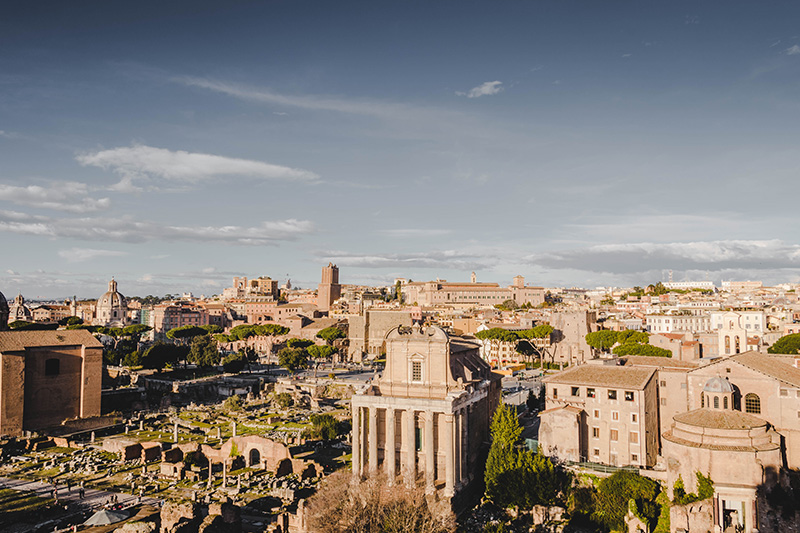
In the immediate vicinity is the Roman Forum, the center of public life in ancient Rome, where commercial, religious, and political activities took place. Here you can admire the remains of temples, basilicas, triumphal arches, and the Via Sacra, the main street that crossed the Forum.
The Palatine Hill, one of the seven hills of Rome, dominates the Roman Forum. According to legend, Romulus founded the city here, and in the imperial era, it became the residence of the emperors. The remains of the imperial palaces offer a spectacular view of the city and the archaeological area below.
Not far away are the Imperial Forums, a complex of monumental squares built between 46 BC and 113 AD by various emperors. Particularly impressive are the remains of Trajan's Forum with the famous Trajan's Column, 30 meters high and decorated with a spiral frieze celebrating Emperor Trajan's victories over the Dacians.
Vatican City
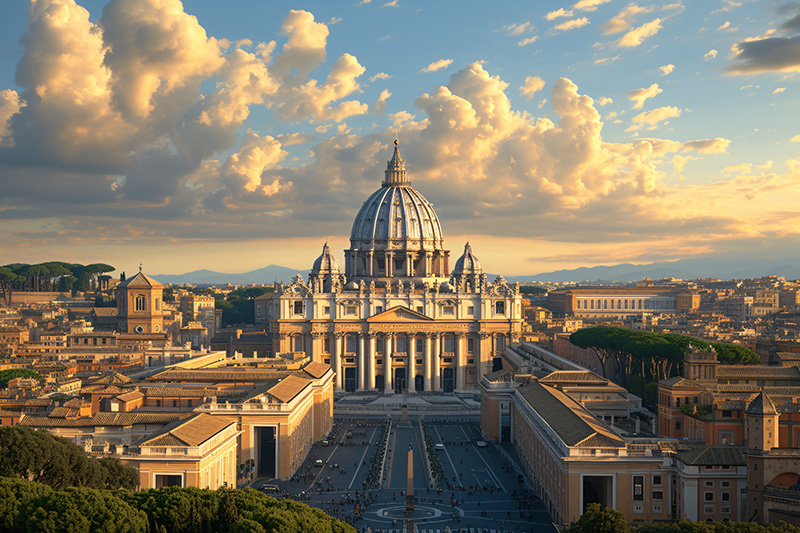
An independent enclave within Rome, Vatican City is the center of the Catholic Church and the residence of the Pope. The majestic St. Peter's Basilica is the largest church in Christendom, designed by some of the greatest architects of the Renaissance and Baroque, including Bramante, Michelangelo, and Bernini. Inside, you can admire masterpieces such as Michelangelo's Pietà and Bernini's baldachin.
Adjacent to the Basilica are the Vatican Museums, which house one of the most important art collections in the world. The museum route culminates in the Sistine Chapel, decorated with Michelangelo's frescoes, including the famous Last Judgment.
St. Peter's Square, designed by Bernini, is one of the most famous squares in the world. With its elliptical colonnade, the square can accommodate up to 300,000 people during papal ceremonies.
Squares and Fountains
Rome is famous for its splendid squares and fountains. Piazza Navona, built on the ancient Stadium of Domitian, is one of the most beautiful baroque squares in the city, dominated by Bernini's Fountain of the Four Rivers.
The Trevi Fountain, the largest and most spectacular fountain in Rome, is a masterpiece of the Baroque. According to tradition, whoever throws a coin into the fountain is destined to return to Rome.
The Spanish Steps, with the famous staircase of Trinità dei Monti and the Fountain of the Barcaccia, is one of the most elegant and photographed places in the city, surrounded by high fashion boutiques.
Campo de' Fiori, instead, hosts a lively market during the day and becomes the center of Roman nightlife in the evening. In the center of the square stands the statue of Giordano Bruno, the philosopher burned at the stake for heresy in 1600.
Churches and Basilicas
Beyond St. Peter's, Rome boasts numerous other churches and basilicas of extraordinary beauty. The Basilica of St. John Lateran is the cathedral of Rome and the oldest church in the West. The Basilica of Santa Maria Maggiore preserves splendid early Christian mosaics and a golden ceiling with gold from the New World.
The Pantheon, originally a Roman temple later converted into a Christian church, is one of the best-preserved ancient buildings, famous for its dome with the central oculus, a circular opening that is the only source of light in the building.
The Basilica of St. Paul Outside the Walls, one of the four papal basilicas, was rebuilt after a fire in 1823 and preserves portraits of all the popes in medallions along the walls.
Museums and Art Galleries
Beyond the Vatican Museums, Rome offers numerous other museums of great interest. The Borghese Gallery, located within the eponymous park, houses an extraordinary collection of sculptures and paintings, with works by Bernini, Canova, Caravaggio, Raphael, and Titian.
The Capitoline Museums, on the Capitoline Hill, are among the oldest public museums in the world, with a rich collection of ancient sculptures, including the famous Capitoline Wolf, symbol of Rome.
The National Roman Museum, divided into four locations (Palazzo Massimo, Palazzo Altemps, Baths of Diocletian, and Crypta Balbi), houses one of the most important collections of ancient art in the world.
For lovers of modern and contemporary art, not to be missed are the National Gallery of Modern Art and the MAXXI - National Museum of 21st Century Arts, designed by Zaha Hadid.
Parks and Villas
Rome is also a green city, with numerous parks and historic villas. Villa Borghese is the "green lung" of the city, a large English park with lakes, temples, and museums, ideal for a relaxing break.
Villa Doria Pamphilj, the largest villa in Rome, offers large green spaces, fountains, and a 17th-century palace. Villa Ada and Villa Torlonia are other historic parks that deserve a visit.
Characteristic Neighborhoods
Trastevere, with its narrow and winding streets, medieval buildings, and lively nightlife, is one of the most charming neighborhoods in Rome. The Jewish Ghetto, one of the oldest in the world, preserves traces of its millennial history, including the Synagogue and the Theater of Marcellus.
The Monti district, the oldest district of Rome, is today a trendy neighborhood with artisan shops, restaurants, and fashionable venues. Testaccio, the ancient popular district built around Monte dei Cocci (an artificial hill formed by fragments of Roman amphorae), is famous for its traditional cuisine and nightlife.
Less Known but Fascinating Attractions
Beyond the most famous attractions, Rome hides treasures less known but equally fascinating. The Catacombs, ancient underground cemeteries used by the early Christians, offer a unique insight into early Christian Rome.
The Appian Way, the Roman "queen of roads," is an open-air museum with tombs, villas, and aqueducts. The Centrale Montemartini, a former power plant transformed into a museum, presents a suggestive contrast between industrial machinery and ancient statues.
The EUR district, designed during Fascism for the Universal Exposition of 1942 (never realized due to the war), is an interesting example of rationalist architecture, with buildings such as the Palace of Italian Civilization, known as the "Square Colosseum."
Attractions for Families
Rome also offers numerous attractions for children. Bioparco, the Rome zoo located within Villa Borghese, hosts about 1,000 animals of 200 different species. Explora, the Children's Museum, offers interactive activities to stimulate learning through play.
The Zoological Garden, one of the oldest in Europe, and the EUR Amusement Park are other ideal destinations for a family day.
Shopping and Markets
For shopping lovers, Rome offers endless possibilities. Via dei Condotti and the adjacent streets host high fashion boutiques and luxury jewelry stores. Via del Corso is the main commercial artery of the center, with shops for all tastes and budgets.
Rome's markets are an attraction in themselves: the market of Campo de' Fiori, active since 1869, offers flowers, fruits, vegetables, and gastronomic specialties. The Porta Portese market, open only on Sunday mornings, is the largest flea market in Rome, where you can find everything from antiques to vintage clothing.
Roman Cuisine
A fundamental aspect of the Roman experience is gastronomy. Roman cuisine, simple but tasty, is based on poor ingredients transformed into unforgettable dishes: carbonara, amatriciana, gricia, cacio e pepe are just some of the first courses not to be missed.
Among the second courses, saltimbocca alla romana, abbacchio, and coda alla vaccinara. Roman or Jewish style artichokes are typical side dishes, while pizza by the slice represents a perfect snack during tourist walks.
Not to forget the desserts, such as maritozzo with cream or ricotta and sour cherry tart, to be accompanied by a good Italian coffee.
When to Visit Rome: The Best Time
Rome is a city that can be visited all year round, but each season has its peculiarities and offers a different experience. Here is a guide to choosing the best time for your trip to the Eternal City.
Spring (March-May)
Spring is considered by many the ideal time to visit Rome. Temperatures are mild (15-25°C), gardens and parks are in bloom, and days are getting longer, allowing you to make the most of your time for visits. The cherry blossoms in Villa Borghese and the azaleas on the Spanish Steps offer an enchanting spectacle.
April and May are particularly pleasant months, although they can already be quite crowded. Keep in mind that during Holy Week and Easter weekend, Rome is a destination for numerous pilgrims for religious celebrations, resulting in increased prices and crowds, especially in the Vatican.
April 21st celebrates the Birth of Rome, the anniversary of the city's foundation, with events, historical reenactments, and free admission to many museums and archaeological sites.
Summer (June-August)
Roman summer is hot and sunny, with temperatures that can exceed 30°C. July and August are the hottest months and also those when the city is less crowded with tourists, as many Romans leave the city for vacations, especially in August.
Despite the heat, summer offers the opportunity to experience Rome in a different way: numerous outdoor events, from film screenings to concerts, enliven the evenings. The Roman Summer, a series of cultural events that takes place from June to September, offers theatrical, musical, and cinematic performances in suggestive locations such as parks, squares, and archaeological sites.
June 29th celebrates the feast of Saints Peter and Paul, patrons of Rome, with religious ceremonies and fireworks. Another suggestive event is the White Night, when museums, art galleries, and shops remain open until late at night.
To mitigate the summer heat, Rome offers numerous public fountains (the "nasoni") where it's possible to refresh and refill water bottles. Additionally, Roman churches, besides being treasure chests of art, offer pleasant coolness.
Autumn (September-November)
Autumn is another ideal season to visit Rome. Temperatures are pleasant (15-25°C in September and October, 10-20°C in November), summer crowds have disappeared, and the city resumes its normal rhythm after the summer break.
The autumn colors of Roman parks are particularly suggestive. Moreover, September and October are the months of the grape harvest, an excellent opportunity to taste local wines in the numerous wine bars of the city.
During this period, important cultural events also take place, such as the Rome Film Festival (October) and RomaEuropa Festival, an important showcase of contemporary theater, dance, and music.
Winter (December-February)
Roman winter is generally mild (5-15°C), with rare snowfalls. December is a magical month, with Christmas lights adorning the streets and Christmas markets in Piazza Navona and other locations. December 8th, the feast of the Immaculate Conception, traditionally marks the beginning of the Christmas holidays, with the lighting of the Christmas tree in Piazza Venezia.
The Christmas period is particularly suggestive in the Vatican, with the large nativity scene and the Christmas tree in St. Peter's Square. The Christmas Mass celebrated by the Pope in St. Peter's Basilica is a solemn event that attracts faithful from all over the world.
January and February are the least touristy months, ideal for those who wish to visit museums and monuments in tranquility, avoiding queues. Moreover, this is the period of winter sales, an excellent opportunity for shopping.
In February, the Roman Carnival is celebrated, with costume parades, street performances, and activities for children. Although it doesn't have the fame of the Venice Carnival, it still offers a fun and colorful experience.
Annual Events Not to Be Missed
In addition to seasonal events, Rome hosts numerous manifestations that repeat annually. The Rome Marathon, which usually takes place on the third Sunday of March, attracts athletes from all over the world with a route that passes through the most suggestive places of the city.
June 2nd, Republic Day, is celebrated with a grand military parade along Via dei Fori Imperiali and the flyover of the Frecce Tricolori.
During the summer, the Circus Maximus and the Baths of Caracalla host concerts of international artists and opera performances outdoors.
In autumn, in addition to the Film Festival, the Rome Fashion Week takes place, an unmissable event for fashion enthusiasts.
Practical Tips for Every Season
Regardless of the chosen season, here are some practical tips for your visit to Rome:
In spring and summer, it is advisable to visit outdoor archaeological sites in the early morning or late afternoon, avoiding the heat of the central hours.
In summer, always carry a water bottle (refillable at the "nasoni"), a hat, and sun protection. In autumn and winter, dressing in "layers" is the best solution, as temperatures can vary considerably between morning, afternoon, and evening.
During Christmas and Easter holidays, book accommodation and tickets for the main attractions well in advance.
In case of rain, take advantage of the numerous museums and art galleries in the city.
To avoid crowds, visit the most popular attractions during the first opening hours or shortly before closing.
B&B Flat - Urban Suites: Your Refuge in the Eternal City
After an intense day discovering the wonders of Rome, nothing is more precious than a comfortable refuge where you can rest and recharge your energy. B&B Flat - Urban Suites represents the ideal solution for your stay in the Capital, combining comfort, quality services, and strategic location.
Quality Accommodation
B&B Flat - Urban Suites offers elegant and functional rooms, all equipped with private bathrooms, an indispensable comfort element for those who desire privacy and independence during their stay. The rooms are carefully furnished with a contemporary design that combines aesthetics and functionality, creating a welcoming environment where you can feel at home.
Each room is equipped with essential comforts to make your stay pleasant: air conditioning for hot summer days, heating for cooler months, flat-screen TV, free high-speed Wi-Fi, and a comfortable private bathroom with shower, courtesy set, and hairdryer.
Daily cleaning guarantees high hygiene standards, while quality linens and ergonomic mattresses ensure restorative rest after long days spent exploring the city.
Strategic Location in a Well-Served Area
B&B Flat - Urban Suites is located in Via Ettore Franceschini 71, in the quiet area of Colli Aniene, residential but at the same time strategic and well connected with the historic center and the main attractions of Rome.
The location is particularly advantageous for those who wish to discover Rome in an authentic way, far from tourist chaos but with easy access to the main points of interest. The Ponte Mammolo metro station (line B) is a few minutes' walk away and allows you to reach the Colosseum, Imperial Forums, Spanish Steps, and other attractions in the historic center very quickly.
Numerous bus lines also connect the neighborhood with other areas of the city, while for those traveling by car, the structure has agreements with nearby parking lots.
The area is well served by restaurants, cafes, supermarkets, pharmacies, and other essential services. Nearby are also Tiburtino Park and La Sapienza University, the largest university in Europe, which contributes to making the area lively and dynamic.
Services and Comfort for an Impeccable Stay
B&B Flat - Urban Suites offers numerous services designed to make your stay in Rome as comfortable as possible. Reception is available at set times for welcome, check-in, tourist information, and general assistance.
To start the day, guests can use the breakfast service, with a ticket for the bar/pastry shop just outside the structure, and have a wide range of snacks available inside the B&B throughout the stay. For coffee lovers, a Nespresso machine with a selection of coffees is available, to be enjoyed in the tranquility of your room. Additionally, each room is equipped with a Smart TV with access to platforms like Netflix and Prime Video, for entertainment at the end of a day of visits or work.